Does anything imply something else as well as itself?
The Principle of Inclusion may be considered the "phenomenological principle." One should consider any event or object in its context. A fly is not just a fly but a fly on the wall, a fly eating, a fly flying from one point to another.
The drawing here portrays just one object. But that object splits up into two kinds of looping forms, as much as a world branches out, but is related to, its original world-point.
This drawing won an "honorable mention" at a Spring 2011 art show. I thought it was the weakest of the three I presented. But at least it was "mentioned."
Wednesday, July 6, 2011

Sunday, June 26, 2011

Monday, May 9, 2011
Commentary on Ancient Seven
"Seven" in various symbols (Greek, Latin, Ugaritic) was a number of completion from the Ancient Near East literature til today. A triad of sevens--i.e., "21"--constitutes this mathematical set of squares.
Tuesday, December 28, 2010

Monday, October 25, 2010
Commentary on Mystic Square
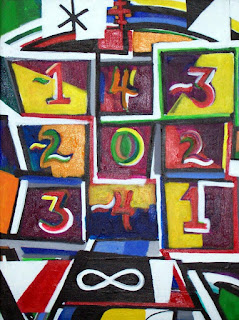
The so-called "magic squares" consist of a grid of various numbers of rows and columns wherein no matter which way one adds the numbers the sum is always the same. It becomes more complicated as the numbers and rows increase.
Mystic Square is a simple 3 x 3 gridwork wherein the sum is always "0" regardless whether one moves horizontally, vertically, or diagonally through any series of three numbers.
The Nothing as a beginning leading to the Unbounded or Infinity is a religious perspective in more than one culture.
Mystic Square is a simple 3 x 3 gridwork wherein the sum is always "0" regardless whether one moves horizontally, vertically, or diagonally through any series of three numbers.
The Nothing as a beginning leading to the Unbounded or Infinity is a religious perspective in more than one culture.
Friday, September 17, 2010
Commentary on Eddington's Glome etc.
I thought of painting Eddington's Glome after reading an essay by Arthur Eddington. He had described, or attempted to do so, the image of a four-dimensional sphere. I figured it would be interesting to paint a flat image using his explanation. Also, a quote by Eddington enlightens: "We are bits of stellar matter that got cold by accident, bits of a star gone wrong."
A Level Meeting Place begins at the edges as a flat, two-dimensional work then becomes three-dimensional, though impossibly so.
The last painting, Prize of Pythagoras, is based loosely on the 3/4/5 right triangle and the Pythagorean tetrakys (think of the set-up of bowling pins) wherein ten points make up a triangle. What I have done here is to distribute the ten points among the triangles from one to four each.
Thursday, September 16, 2010


Wednesday, September 15, 2010


Subscribe to:
Posts (Atom)