 |
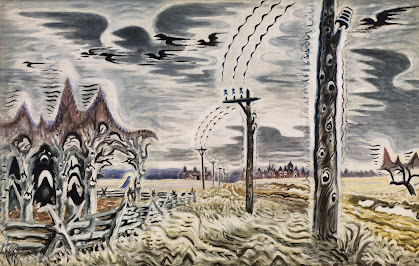
Song of the Telegraph (1952), watercolor on paper, 53" x 34"
|
Charles E. Burchfield lived in the Great Lakes region of
the US, born in Ohio then moving to Western NY to reside in West Seneca, a
suburb of Buffalo, NY. His body of work
presents a keen interest in the immediate environment where he grew up and then
lived later in life, employing an approach that is not the traditional western
representation and borders on the fantastic in some instances.
So, there is a challenge to critics in evaluating
Burchfield as Art historians find it difficult to place him into a category:
Surrealist? Superrealist? Magic Realism? None of these fit his imagery since there is
no direct line evident in any of his drawings or paintings and, as many Art
critics or historians will do, they find it easier to pass off Burchfield’s
work as “Regionalism” or pronounce that he was a “regional artist.”
That’s not a bad description necessarily—I’d be happy if
any art critic even bothered to say that about me—but this label tends, if not intended
by the critics deliberately, to demote the artist as someone who was not
following the prevailing or influential styles of their time and bounded out
along on their own personal journey that is too idiosyncratic. Not bringing together the styles current of
the artist’s time simply makes it more difficult to comprehend someone who is
unique.
One may think that those in the Art world would welcome
this kind of creativity but instead, and unfortunately, it becomes the
albatross around the neck of the artist.
The creative originality is not thought of as intriguingly fresh but as
“regional” or “eccentric.” That’s too
bad, since many will take these kinds of criticisms as pertinent to the
artist’s work without considering that the imagery provides a fresh
perspective.
Admittedly, in my college days as an art student I wasn’t thrilled
by Burchfield’s work. I thought that some
of the paintings and drawings caught the essence of urban and rural landscapes
of Western New York (we like to capitalize the “W” so as to make it a
distinctive geographic title). Still, on
the whole I was puzzled that he did not try to push a bit more into the other
new ways of his era in order to apprehend a subject through the visual art.
And that’s exactly what is good about Burchfield, while he
did draw upon other streams of depicting the world he made them his own. Today, I appreciate his vision. Not only plants and building, but even insects
make their way into view; I know that there is more to Art than re-presenting
insects, but even those who are more traditional landscape painters rarely give
them the spotlight.
There are still a few drawings and paintings within the Burchfield
oeuvre that just do not attract me.
On the whole, however, I see him as an outstanding artist who presented
another vision of reality.


